
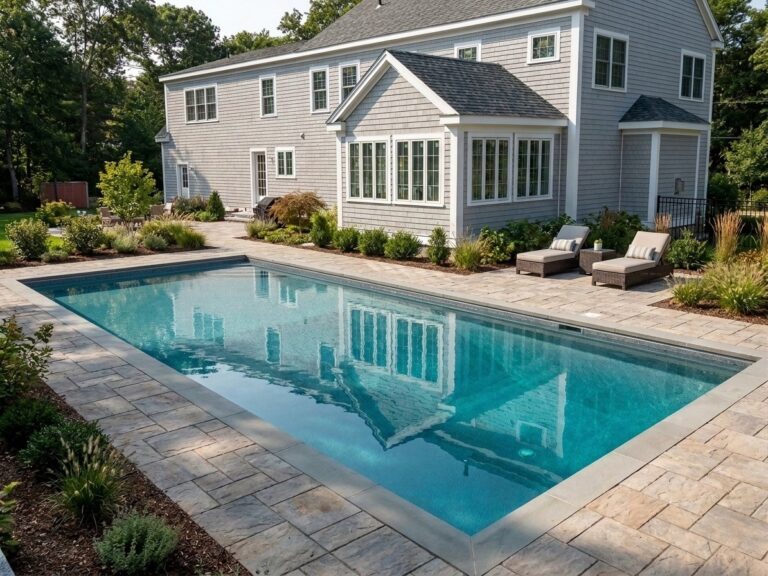
If you’ve ever stared at a pool test kit trying to figure out what the numbers actually mean, you’re not alone. Pool water chemistry can feel like a science class at first, but once you understand the basic principles, it becomes intuitive. Getting your chemistry right is the single most important thing you can do to keep your pool water safe, clear, and comfortable — and to protect your pool equipment and surfaces over the long term.
pH: The Foundation of Water Balance
pH measures how acidic or basic your pool water is, on a scale from 0 to 14. A pH of 7 is neutral. Pool water should be maintained between 7.2 and 7.6 — slightly alkaline. This range is close to the natural pH of human eyes, which is why properly balanced water doesn’t sting.
If your pH drops below 7.2, the water becomes acidic. Acidic water is corrosive — it irritates swimmers’ eyes and skin, eats away at pool surfaces, and degrades equipment like pump seals and heat exchanger components. If pH climbs above 7.8, the water becomes too alkaline, which reduces the effectiveness of chlorine and can cause cloudy water and scale buildup.
Raise pH with sodium carbonate (soda ash). Lower it with muriatic acid or sodium bisulfate (dry acid).
Total Alkalinity: The Buffer
Total alkalinity (TA) measures the concentration of alkaline compounds in the water — primarily bicarbonates. Think of it as the buffer that keeps pH from swinging wildly in response to small changes. Low alkalinity makes pH unstable and hard to control. High alkalinity makes it difficult to adjust pH at all.
For most pools, the ideal total alkalinity range is 80 to 120 ppm (parts per million). Raise TA with sodium bicarbonate (baking soda). Lower it by adding muriatic acid and letting the water circulate with the pump running.
It’s important to adjust total alkalinity before trying to correct pH, since TA has a direct influence on how pH behaves.
Chlorine: Your Primary Sanitizer
Chlorine is the workhorse of pool sanitation. It kills bacteria, viruses, and algae, keeping your water safe to swim in. But there’s more to chlorine than simply adding it and moving on.
Free chlorine refers to the active chlorine available to sanitize. It should be maintained between 1 and 3 ppm. Combined chlorine (chloramines) forms when free chlorine reacts with ammonia and nitrogen compounds from sweat, urine, and other contaminants. Chloramines are what cause the unpleasant chemical smell often associated with pools — ironically, a strong pool smell is a sign of too little free chlorine, not too much.
Shocking your pool — adding a large dose of chlorine — breaks down chloramines and restores free chlorine levels. Most pools benefit from shocking weekly during peak season, and always after heavy use or a rainstorm.
Calcium Hardness and Cyanuric Acid
Calcium hardness measures the amount of dissolved calcium in your water. Too little calcium, and the water becomes aggressive and will leach calcium from your pool surfaces, causing etching and pitting. Too much, and you get scale deposits on surfaces and equipment. The target range is 200 to 400 ppm.
Cyanuric acid, sometimes called stabilizer or conditioner, protects chlorine from being broken down by UV sunlight. Without it, outdoor pools can lose most of their free chlorine within a few hours of direct sun exposure. The ideal range is 30 to 50 ppm. Too high, however, and cyanuric acid begins to reduce the effectiveness of chlorine — a phenomenon known as chlorine lock.
Testing all of these parameters regularly — ideally twice a week during summer and once a week in cooler months — gives you the information you need to keep your water in balance before small imbalances become big problems.